


Screenloop x Brainfood RecFest Recap: Hot takes, highlights, and the future of TA (2026)
Screenloop joins Hung Lee's Brainfood to chat highlights from RecFest 2026, from the EU AI Act, human-in-the-loop, and whether candidates are losing trust

On 2 July, thousands of TA and recruitment folk descended on Knebworth Park for RecFest 2026, one of the biggest events in the industry calendar. Between the sunshine and the festival stages, there was no shortage of big ideas about the future of hiring. We caught up with Hung Lee in a special edition of Brainfood to chat through some of the big discussion points, from AI regulation to the candidate trust crisis.
Prefer to watch or listen to the episode?
Select your channel of choice below.
Without further ado, here's what we covered.
1. Is the TA community braced for AI legislation?
We began with the question we’ve all been asking: Have we reached peak AI hype? And, if so, are we adequately prepared for the potential legal or compliance fall-out?
From where we’re standing, many recruitment teams look to be playing catch-up. The technology is moving at the speed of light. But teams on the ground don’t have the legislative controls or guidance in place yet to protect both themselves and candidates.
The EU AI Act came into force back in 2024 – but TA pros will need to keep December 2027 in mind. This is when organisations using ‘high-risk systems’ for recruitment (think screening or candidate scoring) will need to comply with specific obligations.
This is a real concern for folks in the TA space. The topic recently took off on LinkedIn after our CEO, Michael, shared an article about AI tooling and discrimination lawsuits. Keen to join the conversation? We'd love to know your thoughts in the LinkedIn comments.
💡 Food for thought: What’s your take? In the pursuit of innovation, are teams losing sight of compliance and candidate experience?
2. Is the human in your loop doing enough?
This next point is a real AI red flag – and your teams may be doing it unthinkingly.
More and more firms are defending their AI usage with one line: 'But we still have a human in the loop'. The trouble is, that human is often just rubber stamping (a cursory review of AI output). If your team is giving a token, two-minute glance at an AI-screened shortlist before signing it off, it's not enough to meet GDPR, DPA and EU AI Act obligations.
Firms will need to have a consistent track record of humans ‘meaningfully’ engaging with AI output, ideally interrogating and challenging it. The ICO’s guidance on this is well worth a read.
💡 Food for thought: If someone audited your process tomorrow, could you prove your humans are genuinely challenging the AI — not just signing it off?
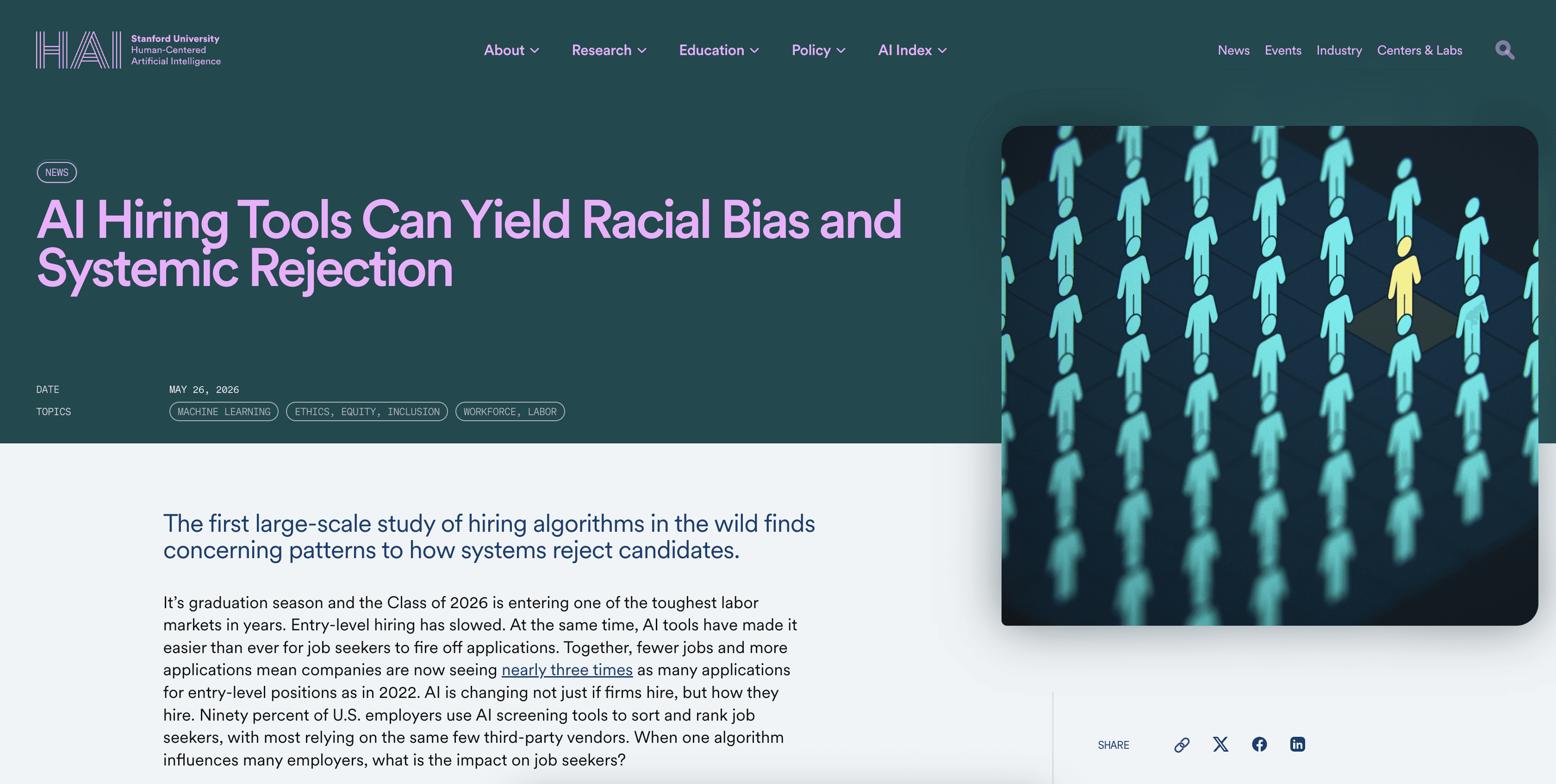
Research from Stanford HAI finds AI hiring tools can produce racial bias and systemic rejection - a timely reminder of why meaningful human oversight matters. (Source: Stanford HAI)
Did you know…?
AI note takers are a low-risk way to add AI and efficiency to your process, without risking decision-making AI that may impact candidates. To find out more, sign up for a free demo of our interview intelligence and AI note taker here.
3. Candidates and AI: are we in a trust crisis?
So far we've focused on the humans on your team. But what about the ones on the other side of the process, the ones at the heart of everything TA teams do - the candidates?
AI tools are saving teams a tonne of time and effort. But that benefit isn’t necessarily felt by candidates. Some will feel alienated by AI-enabled hiring tools, lost in a sea of automated processes, or mistrustful of tech that may reinforce recruiting bias.
This isn’t a new phenomenon. Since Applicant Tracking Systems entered the scene, we’ve seen the rise of automated hiring processes: Screening questions, CV parsing, candidate scoring. And in the background there’s always been murmurs of applicants falling into the ‘ATS black hole’.
But this conversation around AI feels bigger - much bigger. And it’s not just reserved for recruitment tools. Using AI to produce careers site copy, job ads, and comms can also impact trust. Candidates are increasingly wary of content that doesn’t sound authentic.
There's no easy fix for regaining candidate trust on the whole, but teams may find that transparency in how they use AI is both a relief to the candidate and a real differentiator. Be upfront about where AI sits in your hiring process using simple, jargon-free language. Ensure that there are human touch points alongside any AI-assisted communication or automation. To help build trust, try using real, human-centric imagery, copy that doesn’t sound like ChatGPT, and personalised feedback where possible.
Be open and clear on your expectations around candidates' use of AI. We've previously praised Monzo's candidate guidance on using AI when applying to work for them.
There should be empathy, too. If teams are using AI to write job descriptions and assess candidates, they shouldn't be surprised when candidates use AI in their applications, especially if there is no guidance around it.
💡 Food for thought: Have you found a way to balance automation and human connection across your toolset and candidate comms?

4. Automation: What do we do with the time saved?
We often conflate AI and Automation.
Automation has been around for years (and since the dawn of the ATS). While we may be AI-ed out, we all benefit from BAU automation when it’s done well.
The elephant in the room is this: If we expect automation + AI to save TA professionals even more time across sourcing, talent intelligence and recruiting, how are we going to continually demonstrate our value?
This could look like becoming more involved in workforce planning, employer branding and long-term talent strategy. Mapping out the talent pipeline and understanding both where a hire adds value now, and how their role can evolve in future.
How do we measure that impact?
As an industry, we’ve been beholden to targets around hiring velocity. Now, we may need to start looking at metrics tied to business intelligence and performance.
The good news is that this kind of scenario rarely happens overnight. So, as your processes evolve, you can develop new reporting frameworks and success metrics to align with wider business and talent outcomes.
💡Food for thought: Are you already feeling this shift? When we make a process more efficient with AI + automation, how do we make sure that time-savings are invested in quality actions?
Final thoughts
AI isn't going anywhere, but the teams who'll thrive are the ones keeping humans meaningfully in the loop - for their own compliance, for their brand, and for their candidates. To recap the practical steps:
Revisit your data-mapping and compliance activity: have you identified your 'high risk' systems in line with the EU AI Act?
Swap rubber stamping for meaningful interrogation of AI output.
Review your candidate journey: where can you amplify the human?
Look beyond TA metrics, and align your team's output with business metrics to demonstrate value.
A big thank you to Hung Lee and our brilliant panelists for such a thought-provoking conversation - we've linked their LinkedIns below so you can follow them for more insights.
If our recap has whetted your appetite, add RecFest 2027 to your events list - and let us know so we can catch up once there!
🤝 Connect with the panel 🤝
Michael Blakley, CEO @ Screenloop
Akbar Karenga, GTM @ Screenloop
Hung Lee, Curator @ Recruiting Brainfood
Tracy Chau, TA Manager @ RedCarnationHotels
Kanwar Kohli, Global Talent Leader @ Booking.com
Audra Knight, Associate Director Employer Brand @ Foundation Medicine
Ready to see what Screenloop can do for your team? Book a discovery call or drop us a message.
Contributors

Screenloop
Editorial Team
Contributors
Screenloop
Editorial Team
Subscribe to our newsletter


© 2025 Screenloop. All rights reserved.


© 2025 Screenloop. All rights reserved.
© 2025 Screenloop. All rights reserved.
On 2 July, thousands of TA and recruitment folk descended on Knebworth Park for RecFest 2026, one of the biggest events in the industry calendar. Between the sunshine and the festival stages, there was no shortage of big ideas about the future of hiring. We caught up with Hung Lee in a special edition of Brainfood to chat through some of the big discussion points, from AI regulation to the candidate trust crisis.
Prefer to watch or listen to the episode?
Select your channel of choice below.
Without further ado, here's what we covered.
1. Is the TA community braced for AI legislation?
We began with the question we’ve all been asking: Have we reached peak AI hype? And, if so, are we adequately prepared for the potential legal or compliance fall-out?
From where we’re standing, many recruitment teams look to be playing catch-up. The technology is moving at the speed of light. But teams on the ground don’t have the legislative controls or guidance in place yet to protect both themselves and candidates.
The EU AI Act came into force back in 2024 – but TA pros will need to keep December 2027 in mind. This is when organisations using ‘high-risk systems’ for recruitment (think screening or candidate scoring) will need to comply with specific obligations.
This is a real concern for folks in the TA space. The topic recently took off on LinkedIn after our CEO, Michael, shared an article about AI tooling and discrimination lawsuits. Keen to join the conversation? We'd love to know your thoughts in the LinkedIn comments.
💡 Food for thought: What’s your take? In the pursuit of innovation, are teams losing sight of compliance and candidate experience?
2. Is the human in your loop doing enough?
This next point is a real AI red flag – and your teams may be doing it unthinkingly.
More and more firms are defending their AI usage with one line: 'But we still have a human in the loop'. The trouble is, that human is often just rubber stamping (a cursory review of AI output). If your team is giving a token, two-minute glance at an AI-screened shortlist before signing it off, it's not enough to meet GDPR, DPA and EU AI Act obligations.
Firms will need to have a consistent track record of humans ‘meaningfully’ engaging with AI output, ideally interrogating and challenging it. The ICO’s guidance on this is well worth a read.
💡 Food for thought: If someone audited your process tomorrow, could you prove your humans are genuinely challenging the AI — not just signing it off?
Research from Stanford HAI finds AI hiring tools can produce racial bias and systemic rejection - a timely reminder of why meaningful human oversight matters. (Source: Stanford HAI)
Did you know…?
AI note takers are a low-risk way to add AI and efficiency to your process, without risking decision-making AI that may impact candidates. To find out more, sign up for a free demo of our interview intelligence and AI note taker here.
3. Candidates and AI: are we in a trust crisis?
So far we've focused on the humans on your team. But what about the ones on the other side of the process, the ones at the heart of everything TA teams do - the candidates?
AI tools are saving teams a tonne of time and effort. But that benefit isn’t necessarily felt by candidates. Some will feel alienated by AI-enabled hiring tools, lost in a sea of automated processes, or mistrustful of tech that may reinforce recruiting bias.
This isn’t a new phenomenon. Since Applicant Tracking Systems entered the scene, we’ve seen the rise of automated hiring processes: Screening questions, CV parsing, candidate scoring. And in the background there’s always been murmurs of applicants falling into the ‘ATS black hole’.
But this conversation around AI feels bigger - much bigger. And it’s not just reserved for recruitment tools. Using AI to produce careers site copy, job ads, and comms can also impact trust. Candidates are increasingly wary of content that doesn’t sound authentic.
There's no easy fix for regaining candidate trust on the whole, but teams may find that transparency in how they use AI is both a relief to the candidate and a real differentiator. Be upfront about where AI sits in your hiring process using simple, jargon-free language. Ensure that there are human touch points alongside any AI-assisted communication or automation. To help build trust, try using real, human-centric imagery, copy that doesn’t sound like ChatGPT, and personalised feedback where possible.
Be open and clear on your expectations around candidates' use of AI. We've previously praised Monzo's candidate guidance on using AI when applying to work for them.
There should be empathy, too. If teams are using AI to write job descriptions and assess candidates, they shouldn't be surprised when candidates use AI in their applications, especially if there is no guidance around it.
💡 Food for thought: Have you found a way to balance automation and human connection across your toolset and candidate comms?
4. Automation: What do we do with the time saved?
We often conflate AI and Automation.
Automation has been around for years (and since the dawn of the ATS). While we may be AI-ed out, we all benefit from BAU automation when it’s done well.
The elephant in the room is this: If we expect automation + AI to save TA professionals even more time across sourcing, talent intelligence and recruiting, how are we going to continually demonstrate our value?
This could look like becoming more involved in workforce planning, employer branding and long-term talent strategy. Mapping out the talent pipeline and understanding both where a hire adds value now, and how their role can evolve in future.
How do we measure that impact?
As an industry, we’ve been beholden to targets around hiring velocity. Now, we may need to start looking at metrics tied to business intelligence and performance.
The good news is that this kind of scenario rarely happens overnight. So, as your processes evolve, you can develop new reporting frameworks and success metrics to align with wider business and talent outcomes.
💡Food for thought: Are you already feeling this shift? When we make a process more efficient with AI + automation, how do we make sure that time-savings are invested in quality actions?
Final thoughts
AI isn't going anywhere, but the teams who'll thrive are the ones keeping humans meaningfully in the loop - for their own compliance, for their brand, and for their candidates. To recap the practical steps:
Revisit your data-mapping and compliance activity: have you identified your 'high risk' systems in line with the EU AI Act?
Swap rubber stamping for meaningful interrogation of AI output.
Review your candidate journey: where can you amplify the human?
Look beyond TA metrics, and align your team's output with business metrics to demonstrate value.
A big thank you to Hung Lee and our brilliant panelists for such a thought-provoking conversation - we've linked their LinkedIns below so you can follow them for more insights.
If our recap has whetted your appetite, add RecFest 2027 to your events list - and let us know so we can catch up once there!
🤝 Connect with the panel 🤝
Michael Blakley, CEO @ Screenloop
Akbar Karenga, GTM @ Screenloop
Hung Lee, Curator @ Recruiting Brainfood
Tracy Chau, TA Manager @ RedCarnationHotels
Kanwar Kohli, Global Talent Leader @ Booking.com
Audra Knight, Associate Director Employer Brand @ Foundation Medicine
Ready to see what Screenloop can do for your team? Book a discovery call or drop us a message.
On 2 July, thousands of TA and recruitment folk descended on Knebworth Park for RecFest 2026, one of the biggest events in the industry calendar. Between the sunshine and the festival stages, there was no shortage of big ideas about the future of hiring. We caught up with Hung Lee in a special edition of Brainfood to chat through some of the big discussion points, from AI regulation to the candidate trust crisis.
Prefer to watch or listen to the episode?
Select your channel of choice below.
Without further ado, here's what we covered.
1. Is the TA community braced for AI legislation?
We began with the question we’ve all been asking: Have we reached peak AI hype? And, if so, are we adequately prepared for the potential legal or compliance fall-out?
From where we’re standing, many recruitment teams look to be playing catch-up. The technology is moving at the speed of light. But teams on the ground don’t have the legislative controls or guidance in place yet to protect both themselves and candidates.
The EU AI Act came into force back in 2024 – but TA pros will need to keep December 2027 in mind. This is when organisations using ‘high-risk systems’ for recruitment (think screening or candidate scoring) will need to comply with specific obligations.
This is a real concern for folks in the TA space. The topic recently took off on LinkedIn after our CEO, Michael, shared an article about AI tooling and discrimination lawsuits. Keen to join the conversation? We'd love to know your thoughts in the LinkedIn comments.
💡 Food for thought: What’s your take? In the pursuit of innovation, are teams losing sight of compliance and candidate experience?
2. Is the human in your loop doing enough?
This next point is a real AI red flag – and your teams may be doing it unthinkingly.
More and more firms are defending their AI usage with one line: 'But we still have a human in the loop'. The trouble is, that human is often just rubber stamping (a cursory review of AI output). If your team is giving a token, two-minute glance at an AI-screened shortlist before signing it off, it's not enough to meet GDPR, DPA and EU AI Act obligations.
Firms will need to have a consistent track record of humans ‘meaningfully’ engaging with AI output, ideally interrogating and challenging it. The ICO’s guidance on this is well worth a read.
💡 Food for thought: If someone audited your process tomorrow, could you prove your humans are genuinely challenging the AI — not just signing it off?
Research from Stanford HAI finds AI hiring tools can produce racial bias and systemic rejection - a timely reminder of why meaningful human oversight matters. (Source: Stanford HAI)
Did you know…?
AI note takers are a low-risk way to add AI and efficiency to your process, without risking decision-making AI that may impact candidates. To find out more, sign up for a free demo of our interview intelligence and AI note taker here.
3. Candidates and AI: are we in a trust crisis?
So far we've focused on the humans on your team. But what about the ones on the other side of the process, the ones at the heart of everything TA teams do - the candidates?
AI tools are saving teams a tonne of time and effort. But that benefit isn’t necessarily felt by candidates. Some will feel alienated by AI-enabled hiring tools, lost in a sea of automated processes, or mistrustful of tech that may reinforce recruiting bias.
This isn’t a new phenomenon. Since Applicant Tracking Systems entered the scene, we’ve seen the rise of automated hiring processes: Screening questions, CV parsing, candidate scoring. And in the background there’s always been murmurs of applicants falling into the ‘ATS black hole’.
But this conversation around AI feels bigger - much bigger. And it’s not just reserved for recruitment tools. Using AI to produce careers site copy, job ads, and comms can also impact trust. Candidates are increasingly wary of content that doesn’t sound authentic.
There's no easy fix for regaining candidate trust on the whole, but teams may find that transparency in how they use AI is both a relief to the candidate and a real differentiator. Be upfront about where AI sits in your hiring process using simple, jargon-free language. Ensure that there are human touch points alongside any AI-assisted communication or automation. To help build trust, try using real, human-centric imagery, copy that doesn’t sound like ChatGPT, and personalised feedback where possible.
Be open and clear on your expectations around candidates' use of AI. We've previously praised Monzo's candidate guidance on using AI when applying to work for them.
There should be empathy, too. If teams are using AI to write job descriptions and assess candidates, they shouldn't be surprised when candidates use AI in their applications, especially if there is no guidance around it.
💡 Food for thought: Have you found a way to balance automation and human connection across your toolset and candidate comms?
4. Automation: What do we do with the time saved?
We often conflate AI and Automation.
Automation has been around for years (and since the dawn of the ATS). While we may be AI-ed out, we all benefit from BAU automation when it’s done well.
The elephant in the room is this: If we expect automation + AI to save TA professionals even more time across sourcing, talent intelligence and recruiting, how are we going to continually demonstrate our value?
This could look like becoming more involved in workforce planning, employer branding and long-term talent strategy. Mapping out the talent pipeline and understanding both where a hire adds value now, and how their role can evolve in future.
How do we measure that impact?
As an industry, we’ve been beholden to targets around hiring velocity. Now, we may need to start looking at metrics tied to business intelligence and performance.
The good news is that this kind of scenario rarely happens overnight. So, as your processes evolve, you can develop new reporting frameworks and success metrics to align with wider business and talent outcomes.
💡Food for thought: Are you already feeling this shift? When we make a process more efficient with AI + automation, how do we make sure that time-savings are invested in quality actions?
Final thoughts
AI isn't going anywhere, but the teams who'll thrive are the ones keeping humans meaningfully in the loop - for their own compliance, for their brand, and for their candidates. To recap the practical steps:
Revisit your data-mapping and compliance activity: have you identified your 'high risk' systems in line with the EU AI Act?
Swap rubber stamping for meaningful interrogation of AI output.
Review your candidate journey: where can you amplify the human?
Look beyond TA metrics, and align your team's output with business metrics to demonstrate value.
A big thank you to Hung Lee and our brilliant panelists for such a thought-provoking conversation - we've linked their LinkedIns below so you can follow them for more insights.
If our recap has whetted your appetite, add RecFest 2027 to your events list - and let us know so we can catch up once there!
🤝 Connect with the panel 🤝
Michael Blakley, CEO @ Screenloop
Akbar Karenga, GTM @ Screenloop
Hung Lee, Curator @ Recruiting Brainfood
Tracy Chau, TA Manager @ RedCarnationHotels
Kanwar Kohli, Global Talent Leader @ Booking.com
Audra Knight, Associate Director Employer Brand @ Foundation Medicine
Ready to see what Screenloop can do for your team? Book a discovery call or drop us a message.
Table of Contents
Contributors
Screenloop
Editorial Team
Subscribe to our newsletter